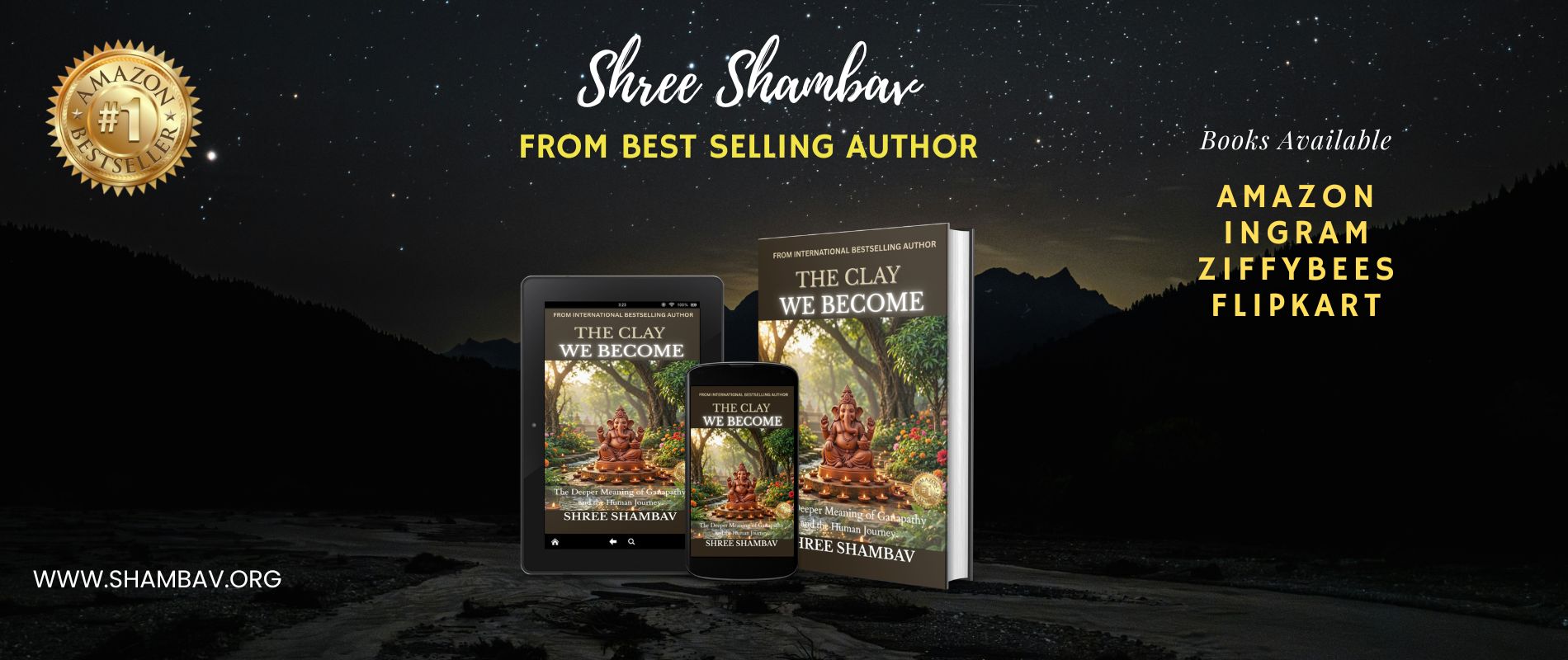
What if the journey of a clay idol is also a reflection of the journey of human life?
The Clay We Become explores the profound symbolism of Ganapathy—from the creation of a clay idol to its final immersion during Visarjan. Through this sacred ten-day journey, the book invites readers to look beyond the festival and discover the deeper meaning hidden within each stage of life.
From birth and growth to relationships, struggle, wisdom, ageing, impermanence, and letting go, each day becomes a mirror of our own human journey. Through conversations, stories, questions, and spiritual reflections, the book gently explores how we are shaped, celebrated, challenged, transformed, and ultimately returned to the source from which we came.
The clay may dissolve, but the journey continues. What disappears in form can remain eternal in meaning.
The Clay We Become is an invitation to see Ganapathy not merely as an idol to worship, but as a profound reminder of who we are, where we come from, and how gracefully we can learn to let go.




"The Clay We Become: The Deeper Meaning of Ganapathy and the Human Journey"
Every year, we welcome Ganapathy into our homes with devotion, joy, music, flowers, prayers, and celebration. We lovingly shape clay into a sacred form, give it a place in our homes and hearts, celebrate its presence, and eventually carry it to the water for Visarjan. But what if this familiar journey holds a deeper message about our own lives?
The Clay We Become looks beyond the celebration of Ganapathy and explores the profound symbolism of clay, form, transformation, and immersion. Ganapathy begins as formless clay, is shaped by human hands, becomes a beloved presence, and eventually returns to nature. In much the same way, human life begins without a defined identity and is shaped by family, relationships, experiences, struggles, achievements, failures, love, loss, and countless choices.
The ten days of Ganapathy become a mirror for the human journey. From birth and wonder to growth and wisdom, from relationships and struggle to impermanence and ageing, and finally to letting go and Visarjan, each stage invites us to pause and reflect on our own existence.
What are we becoming? What truly matters? What are we holding on to? What are we afraid to release? And when our physical form is gone, what will remain of the life we lived?
Through heartfelt conversations with Guruji, stories, questions, analogies, and reflections, the book transforms a familiar festival into an inward journey of understanding. It does not seek to provide final answers; instead, it encourages readers to discover their own questions and contemplate the deeper meaning of life.
The clay reminds us that form is temporary. Our bodies, possessions, titles, relationships, achievements, and circumstances continually change. Visarjan can therefore be understood as a powerful symbol of transformation—the form returns to nature, yet the meaning, memories, love, and spiritual journey do not simply disappear.
The book also explores the spiritual understanding of the Atman, the deeper self that is understood as continuing beyond the physical body. In this perspective, Visarjan is not merely an ending, but a reminder that transformation is part of existence.
The Clay We Become is ultimately an invitation to live more consciously—to celebrate while we are here, love more deeply, learn from our experiences, appreciate what we have, and develop the courage to let go when the time comes.
We are shaped by life, transformed by experience, and eventually returned to the earth. The form may change, but the journey continues.








Seeing Order Beyond Biology: “This book reshaped how I think about life itself. As a medical professional, I am trained to analyze systems in isolation. ... The Architecture of Coherence helped me see life as something relational rather than mechanical. It bridges science and philosophy with rare clarity, showing how order, health, and even consciousness arise from coherence, not control. It is intellectually rigorous yet deeply humbling.”
A New Lens on Complexity: “Running organizations has taught me how fragile systems can be. This book explains *why*. ... Instead of promoting control or optimization, it reveals how coherence emerges through relationships, constraints, and care. The insights on social systems and unintended consequences felt strikingly relevant to leadership and innovation today. This is not theory for theory’s sake—it changes how you act.”
When Philosophy Meets Reality: “What impressed me most is how accessible such deep ideas are. The book never oversimplifies, yet it never overwhelms. ... Concepts like emergence, collapse, and distributed agency suddenly feel practical and human. It changed how I understand organizations, ethics, and responsibility. The Architecture of Coherence doesn’t give rigid answers—it teaches you how to think more wisely within complex systems.”