
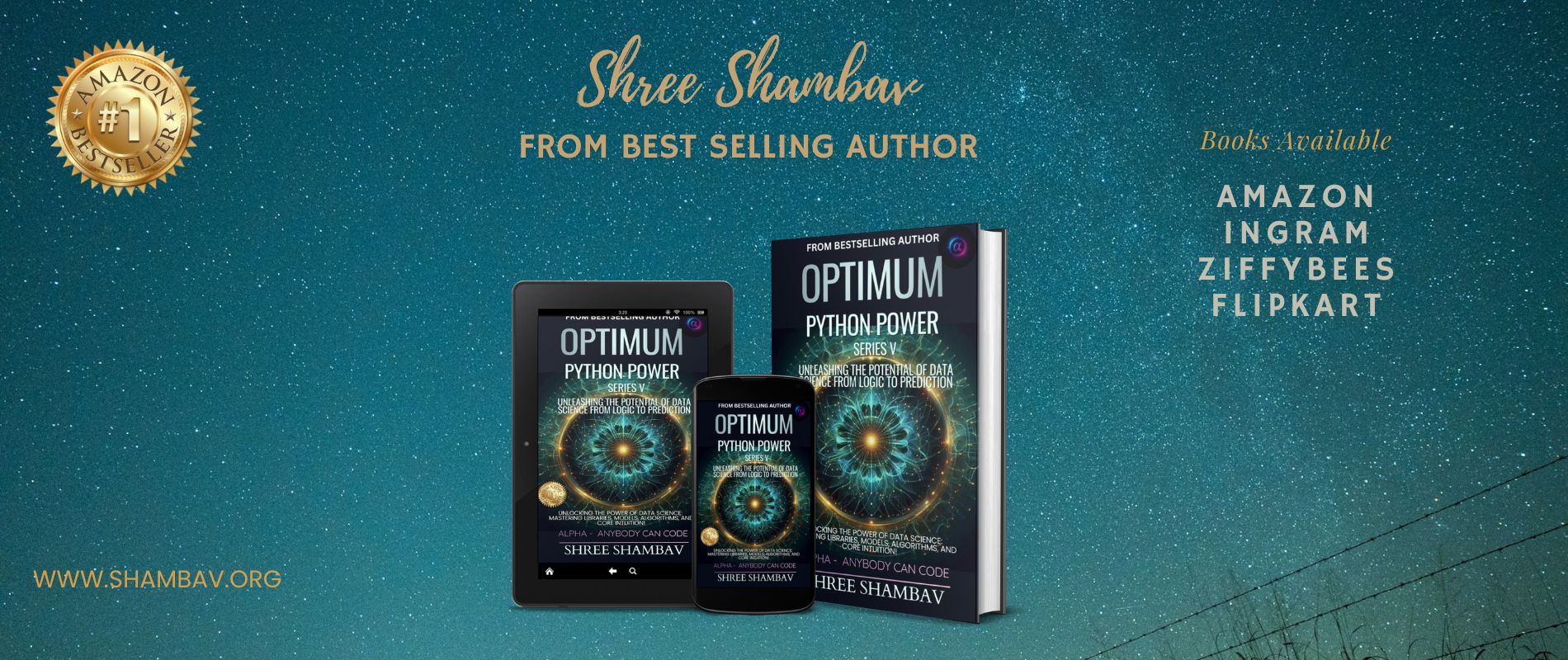
UNLEASHING THE POTENTIAL OF DATA SCIENCE FROM LOGIC TO PREDICTION
Read MoreA Complete Guide to Advanced Machine Learning, Probabilistic Models, Time Series, and Reinforcement Learning With Python.
Optimum: Python Power Series V – Unleashing the Potential of Data Science With Deep Learning Techniques is a practical, code-first guide to advanced machine learning, probabilistic modelling, time-series forecasting, and reinforcement learning. Packed with PyTorch templates, real-world examples, and intuitive explanations, this volume helps learners and practitioners transform theory into production-ready AI solutions
Step into the next level of data science mastery. Optimum: Python Power Series V is a focused, practical, and deeply insightful guide designed to take you from understanding core concepts to building and deploying advanced AI systems. Whether you’re a student, a data scientist, or an engineer, this volume equips you with the intellectual toolkit and implementation know-how required for modern, production-grade machine learning.
Are you prepared to embark on this extraordinary journey into the captivating world of Data Science?



Why this book?
The pace of AI innovation demands learners who not only use tools but understand their foundations. This book bridges that gap: it explains the why behind algorithms, demonstrates the how with clean Python and PyTorch code, and connects both to real-world problems—time-aware forecasting, uncertainty-aware decision systems, and agents that learn from interaction. You’ll gain intuition for model behaviour, practical skills for implementation, and confidence to architect scalable solutions.
What you’ll learn
The book is organized into four cohesive parts, designed to take you from solid foundations to advanced, production-ready intelligence systems.
Part One – Advanced Techniques
Reinforce machine learning fundamentals and extend them to semi-supervised methods, ensemble systems, and model deployment best practices. Learn the full pipeline: data preparation, feature design, evaluation strategies, and robust model selection.
Part Two – Foundations of Probabilistic Models
Master probabilistic reasoning—Naive Bayes variants, Gaussian Processes, Bayesian Networks, Hidden Markov Models, Gaussian Mixture Models, and Expectation–Maximization. Understand MLE and MAP, and learn to reason formally under uncertainty so your systems make principled decisions in noisy environments.
Part Three – Time Series Modelling
Build forecasting expertise through decomposition, stationarity tests, ARIMA/SARIMA/SARIMAX, PACF/ACF-driven model selection, multivariate VAR, Granger causality, and cointegration. Gain practical guidance on handling missing data, backtesting, and evaluating forecasts.
Part Four – Reinforcement Learning
Explore decision-making at scale. From Markov Decision Processes and Bellman equations to DQN variants, Policy Gradient methods, PPO, and advanced actor–critic algorithms such as DDPG, TD3, and SAC. Modern topics include Distributional Reinforcement Learning, Prioritised Experience Replay, and Multi-Agent RL patterns.
Practical, hands-on, and production-minded
This is not a catalog of theory. Each chapter includes clean, reusable PyTorch templates, end-to-end case studies, practical guidance on hyperparameter tuning and model stability, deployment considerations, and exercises to deepen understanding.
Who should read this
Aspiring and practicing data scientists seeking depth beyond tutorials, machine learning engineers preparing models for production, researchers and advanced students needing an implementation-focused reference, and domain professionals in finance, healthcare, energy, and IoT who require robust forecasting or decision systems.
What sets this book apart
A strong emphasis on probabilistic thinking, real-world readiness from preprocessing to deployment, balanced depth combining rigorous mathematics with intuition, and modern PyTorch-based implementations aligned with industry workflows.
Ready to build?
If you’re ready to transform knowledge into capability—forecast trends, design uncertainty-aware systems, and build agents that learn—Optimum: Python Power Series V is your next step. Use it as a course companion, a professional reference, or a project cookbook.









A Masterpiece That Bridges Logic and Intuition... “This book is a rare gem in the AI world. It doesn’t just teach deep learning—it illuminates it. The way it connects mathematical foundations with philosophical insight is extraordinary. Every chapter feels like a journey from curiosity to clarity. I finally understand not just how neural networks work, but why they behave the way they do. A must-read for anyone serious about mastering modern AI.”

A Transformative Journey Into the Heart of AI... “What sets this book apart is its soul. It blends technical mastery with a profound sense of purpose. The storytelling, the conceptual depth, and the philosophical reflections make every page inspiring. I walked away with not just skills—but perspective. ‘Optimum Python Power – From Data to Intelligence’ is a revolution in itself, a true companion for aspiring thinkers, builders, and innovators.”

The Most Complete Deep Learning Guide I’ve Read... “From perceptrons to transformers, this book covers everything with elegance and precision. The explanations are so clear that beginners feel empowered, yet deep enough that practitioners will constantly discover new insights. The sections on attention mechanisms and autoencoders are the best I’ve ever seen. This is more than a book—it’s a reference guide I will return to for years.”